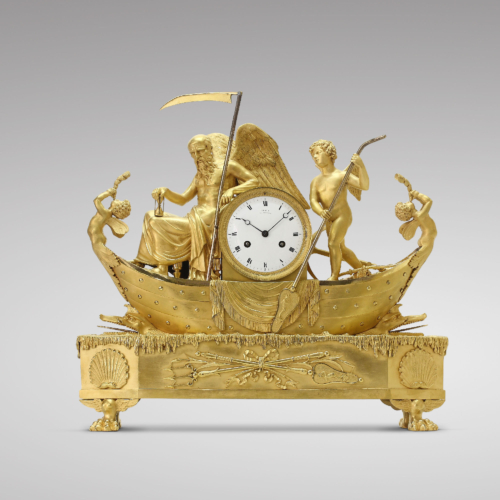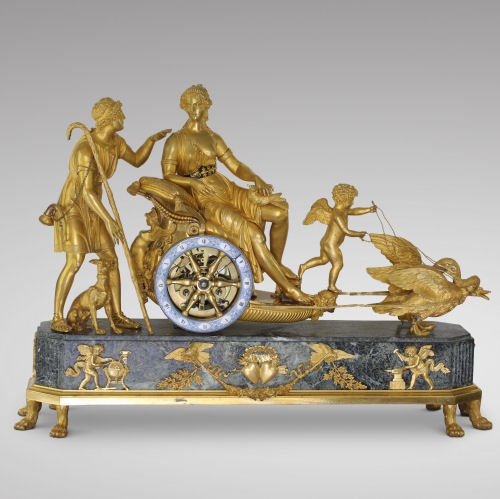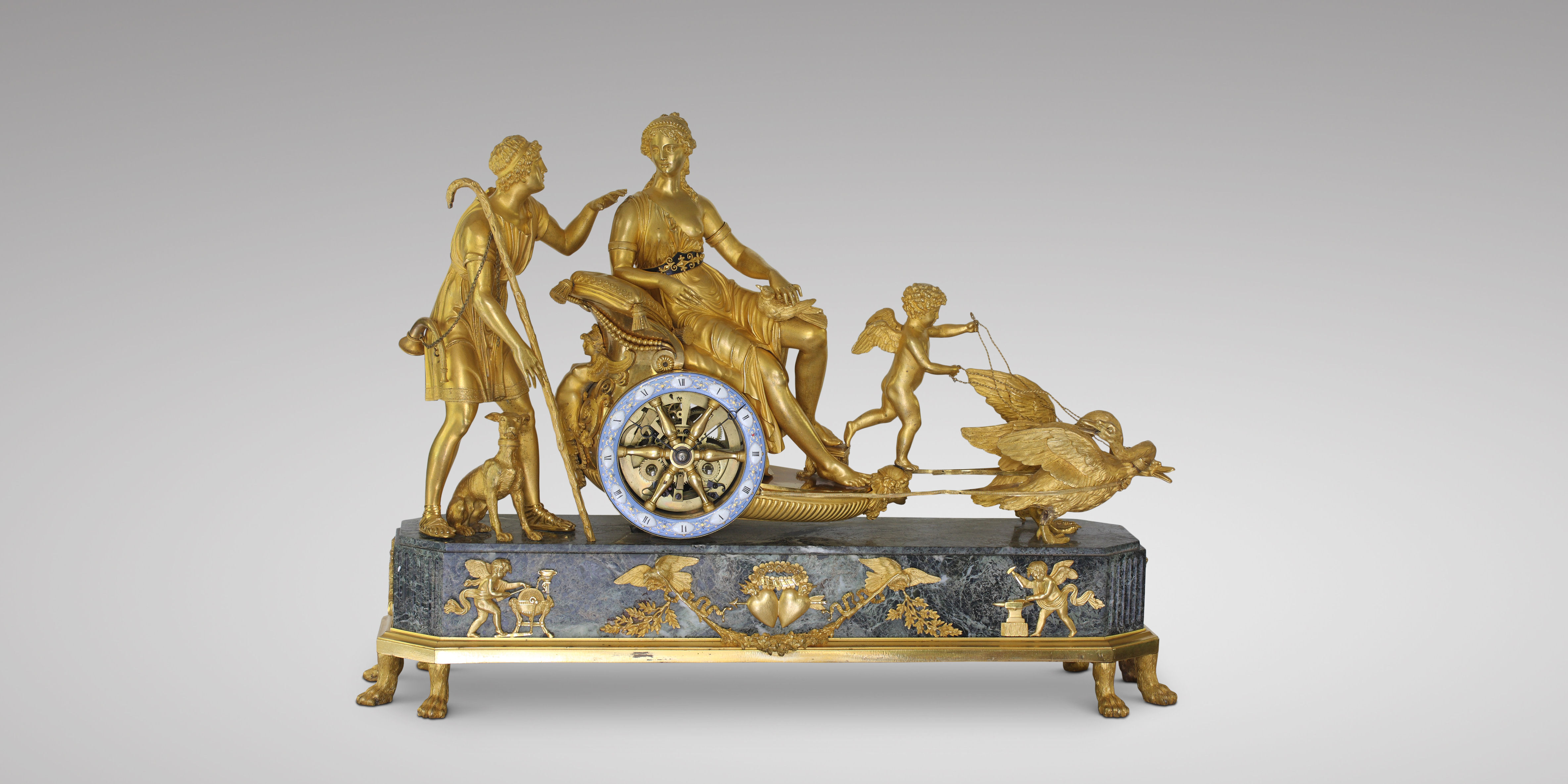
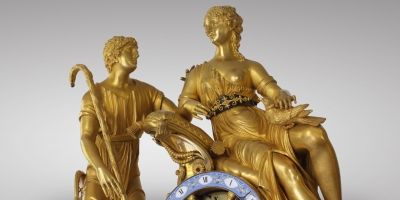
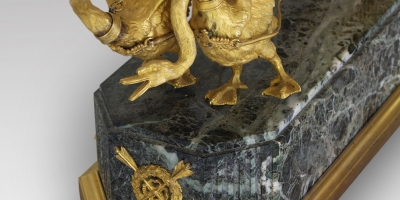
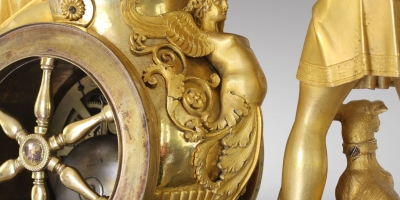
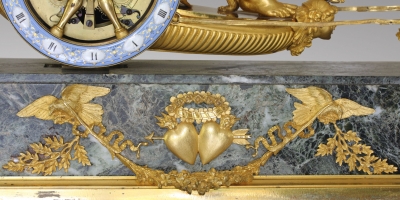
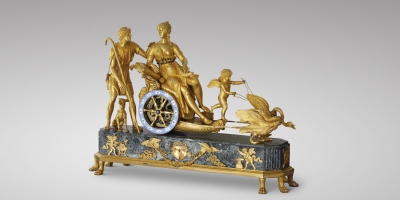
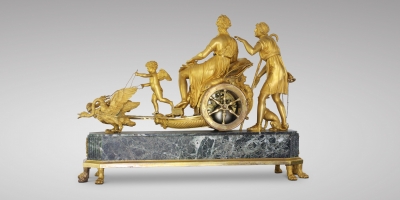
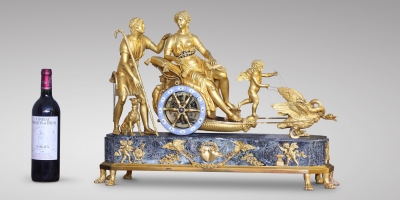
Attributed to André Antoine Ravrio (1759 - 1814) Exceptional Empire period Mantel Clock: “The Chariot Of Venus”, Paris, circa 1805. Chased and gilded bronze,Vert de mer marble plinth, on eight lion-paw feet, dial by Coteau, signed Leroy à Paris. The partially draped Venus, seated in her chariot, a dove on her knee, seems to be conversing with the handsome Adonis, an ardent hunter with whom she has fallen in love; she is assisted by Cupid, who, balancing his weight on one foot, holds the reins of the swan-drawn chariot. Dressed as a simple shepherd, Adonis is accompanied by his dog and carries a horn and hunting spear. The plinth is cast with a chased-bronze frieze decorated with the attributes of love: two doves in flight hold a flower garland centred by a crowned double-heart trophy and are flanked on each side with a cupid forging love weaponry. Executed by Coteau, the ring-shaped dial features Roman hour numerals centred within small gilt-trimmed medallions and a very delicate floral and palmette décor on a light-blue enamel ground. Blued steel Breguet hands indicate the hours and minutes. The dial is set within the chariot’s wheel, its six spokes creating open-work intervals that allow the “skeleton” movement and all its interior elements to be viewed from all sides.
Countwheel strike for the hours and the half hours on a silvered bell, silk suspension, anchor recoil escapement on 4 ½ teeth, two-weeks autonomy.
This scene is based on the tragic love story of Venus and Adonis in Ovid’s Metamorphoses. In the account, Venus falls in love with the handsome hunter Adonis and has to share her love for him with the goddess Proserpina. Fearing for his life, Venus begs her lover not to hunt wild beasts. Adonis, ignoring her plea, is slain by one of the wild boars he pursues. From his blood springs an anemone, a short-lived flower symbolic of his early death.
Regarded in its time as a standard decorative arts subject, the theme of Venus and her chariot was appreciated more for its ornamental value than for its functional qualities: the dial set within the wheel made it difficult to read the time. Under Napoleon I pleasant genre scenes evoking the charms of the art of Louis XVI can be found decorating the palaces. In the domain of clockmaking, the chariot became an increasingly feminine motif. Love, nudity and seduction in a variety of metaphorical terms made gradual inroads in a society dominated by military art. Triggered by popular demand, the swan, mythic symbol of Apollo in love, reappeared in parks – we know that in 1803 Josephine was the first to introduce the black swan to her park at Malmaison; native to western Australia, the black swan was alien to Europe at the time. The swan’s gracefully curved neck became the image of sensuality, replacing the coiled serpent and dolphin so characteristic of the arts of the previous century.
Dimensions
H. 18" (45 cm), W. 25" (63 cm), D. 7 ½" (19 cm)
Maker
After a close study of the model presented here, its original composition can be attributed, like the other existing examples, to the work of Antoine-André Ravrio (1759 – 1814), one of the most important Parisian bronziers of the Empire period. His father, a skilled bronze caster, was respected for his principles and talent, and his mother was related to Riesener, cabinetmaker to the French royal family. Ravrio became master founder in 1777 and figured among the most important Parisian bronziers of late eighteenth-century and Empire period, establishing himself at 93 rue de Richelieu under the name Ravrio et Cie. Official supplier to the Garde-meuble impérial (Imperial Furniture Warehouse), Ravrio participated, alongside the bronziers Thomire and Galle, in the refurnishing of Napoleon’s principal residences and supplied bronze furniture mounts to prominent figures of the period, notably certain marshals of the Empire. He also had commissions to supply the palaces of Fontainebleau, Compiègne, Meudon, Stuppinies and Monte-Cavallo with bronze objects, which included candelabra, chandeliers, candlesticks, lanterns, wall lamps and andirons. The Mobilier national in Paris still houses some of Ravrio’s pieces.
Bibliography
E. Dumonthier, Les bronzes du mobilier national, Pendules et Cartels, Paris Ch. Massin ed., pl. 39; Jean-Dominique Augarde, Les Ouvriers du Temps, 1996, p.144, pl. 109; Maison Leroy, Presentation Leaflet.
Musea
Rueil-Malmaison, châteaux de Malmaison et Bois-Préau, Mobilier National.
Pdf documents to download
 en français
 in English
 in het Nederlands