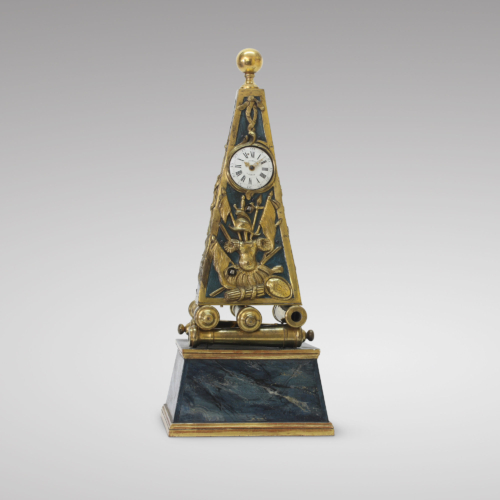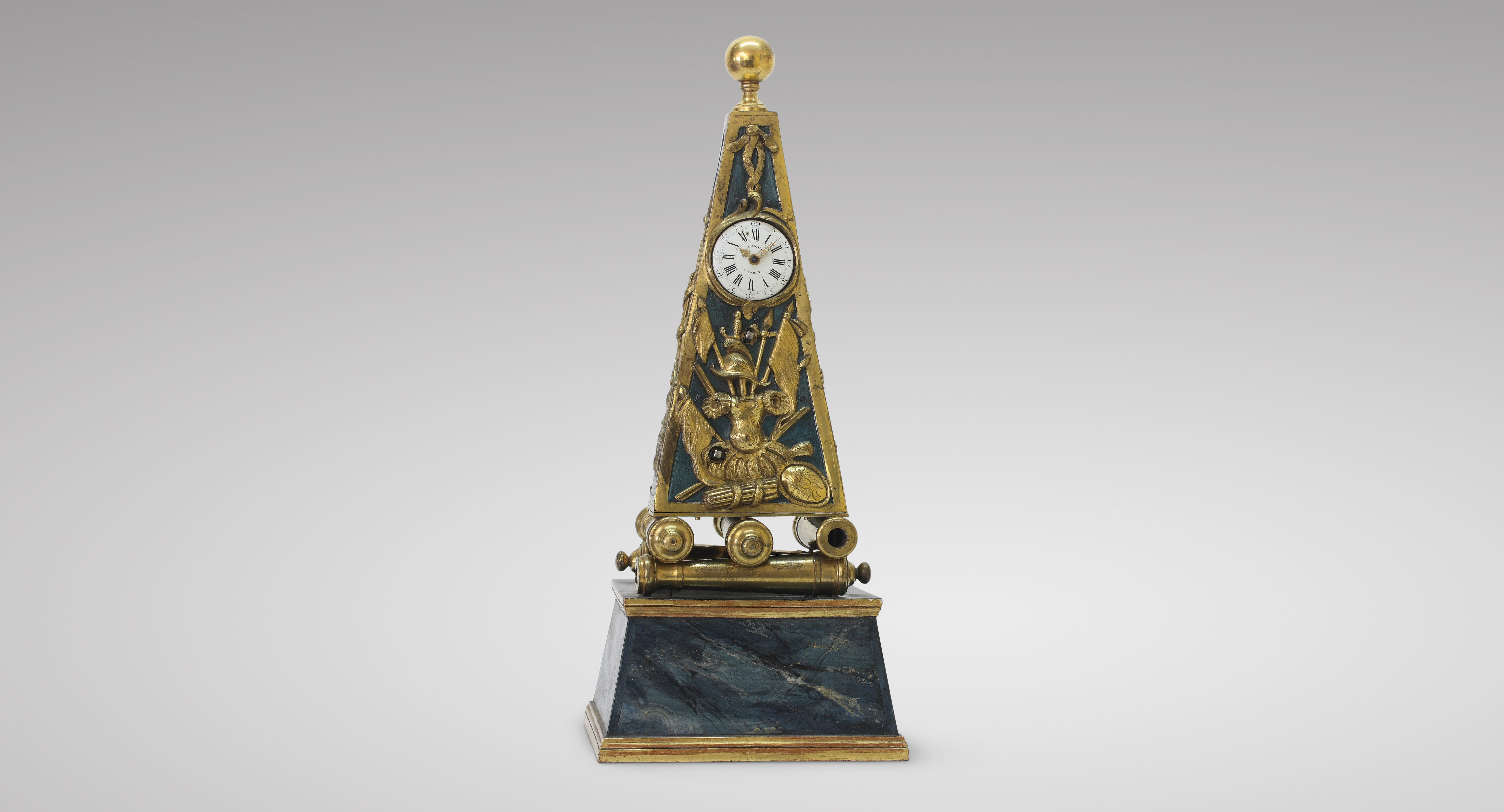
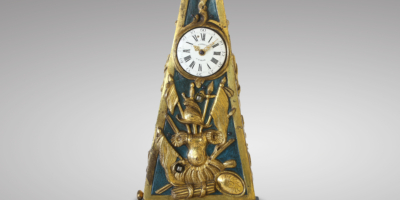
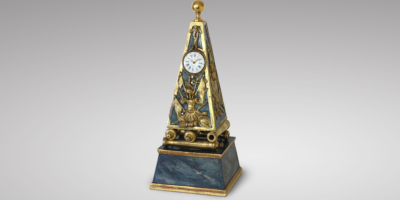
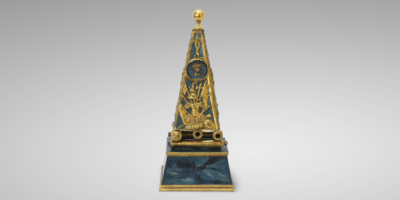
ANTOINE THIOUT, circa 1760, signed on the dial and on the rear movement plate: THIOUT A PARIS.
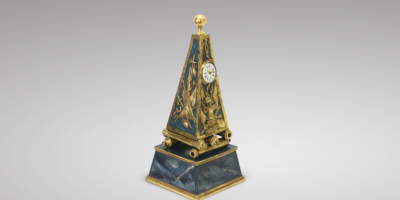
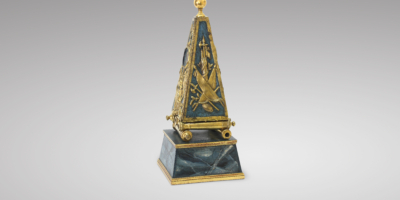
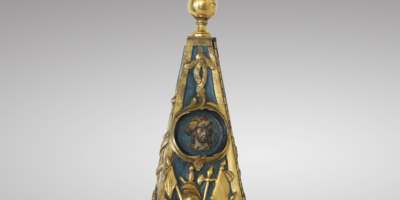
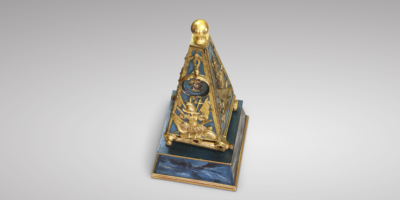
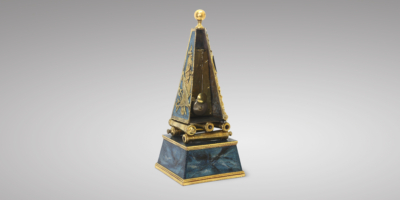
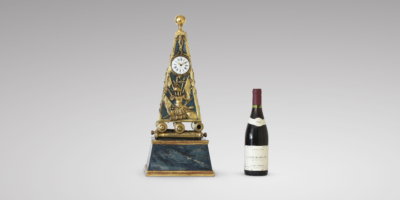
Highly unusual and very rare French “Obelisk” clock with all its military attributes: shell and feathered helmet on a background of trophies of weapons, flags and banners, the sides with a similar décor but without helmet nor shell, a cannonball above and five lying cannons below, on a fluted base. The dial of the clock at the front, and a portrait of a red-haired bearded man with Turkish-style head dress at the rear.
The top cannonball above and the five cannons below in ormolu, the main case in ormolu with painted background, the oak base with faux marble and gilt paint on the edges. (The wooden base later, probably around 1850).
The enamel dial with Roman numerals for the hours and Arabic numerals for the five minutes, with very finely cut and engraved ormolu hands.
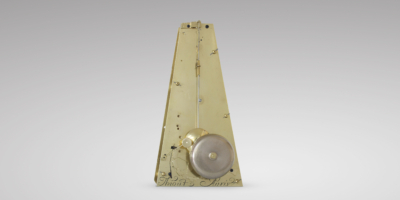
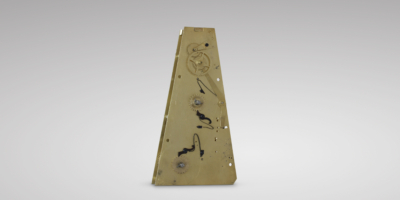
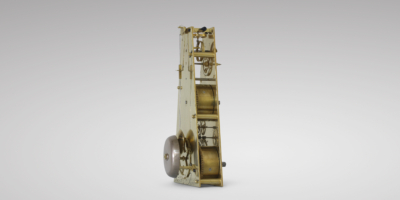
The movement of triangular shape was specially designed, produced and adapted for this very clock, the verge escapement right on top, the movement above and the countwheel strike below, with a silvered bell and silk suspension. Autonomy three weeks.
This remarkable clock is very likely unique, bearing all the characteristics of a stand-alone piece: specially designed movement, bearing all the wheel patterns, traces of displacement for better function, the movement mounted and leaning backwards, with the dial being mounted last from the front.
Made under the reign of Louis XV, our clock is designed well before the appearance of the classical marble “obelisk” clocks that appeared circa 1780 under Louis XVI and later.
Especially ordered as a regiment souvenir for a high-ranking officer, the first owner will remain a mystery. And who is represented on the rear with this “Turkish-style” headdress?
Dimensions
H. 21½ʺ (54cm), W. 9ʺ (23cm), D. 9ʺ (23cm)
Antoine Thiout,
known as l’Aîné (1694-1767). Compagnon in Paris en 1715, received as master in 1724, probably by Trinity Hospital privilege. Garde-Visiteur from 1742 to 1745, Horloger de la Reine Douairière d’Espagne, then Horloger Ordinaire du Duc d’Orléans in 1752. Established Enclos de la Trinité, then Rue du Four, then Quai Pelletier. This brilliant clockmaker presented numerous inventions to the Académie des Sciences, notably equation of time clocks and marine clocks. He also made tools, notably machines for shaping fusees. In 1741 he published his important Traité d’Horlogerie, a book that is still considered to this day as one of the most modern and referenced horology treaty.
Bibliography
Tardy, Dictionnaire des horlogers français, Paris, 1972 ;
Jean-Dominique Augarde, Les ouvriers du Temps, La pendule à Paris de Louis XIV à Napoléon Ier, Genève,1996.
Musea
Paris, Musée du Louvre, Muséee National des Techniques; Saint-Petersburg, Hermitage Museum; Turin, Palazzo Reale
Price
€ 13.500.-
Pdf documents to download
 en français
 in English